
Does a harness pay for itself? Frontier vs cheap models, with and without one
Every time I kick off a coding-agent task, I end up making the same gut call. Do I burn frontier tokens on Opus or Astra, or reach for a cheap model and lean on tests and automated checks to catch whatever it misses? Cheap models cost next to nothing per token, so in theory they can afford to stumble a few times and still come out ahead. Then again, extra check loops burn tokens and wall-clock time too. What actually matters is what each accepted result costs me, failed runs included.
Gut feel only gets you so far, so I built a small benchmark to put some numbers on it. I tested four model setups across two coding tools, three ways of splitting up the work, with and without an added layer of deterministic checks, ten repetitions each. That came to 240 scored workflows, run on 24 and 25 November 2026 (UTC), with an independent evaluator grading every finished workspace at the end.
The result surprised me, mostly because it went the opposite way to what I expected. On this task (a small app with a tight spec), the cheap models working by themselves beat every other setup. They were accepted 38 times out of 40, compared to 18 out of 40 for the frontier models, and for a fraction of the price. Bringing in a frontier model to write a plan or review the code never beat letting the cheap model just get on with it. My added checks barely got a workout either. All 160 check runs passed on the first try, so they never triggered a repair loop. Acceptance landed at 53 of 120 with checks turned on, and 57 of 120 with them off.
Why the frontier models lost is the more interesting story. All 22 of their rejected solo runs failed the exact same test. They spotted an awkward edge case in the crash-recovery rules and made a sensible engineering call about how to handle it, often explaining their reasoning in a comment. Meanwhile, the spec defined the behaviour literally, and the cheap models just followed what it said. Buying a frontier model buys you judgment. That’s what you want on a messy brief. When everything is pinned down upfront, that same instinct can backfire.
Dollar comparisons are cleanest on the Claude side. Codex CLI doesn’t report cache-write tokens, so any dollar figure involving a Codex model is just a floor. On Claude, Haiku 5.5 working alone came out to an estimated $0.043 per accepted result without checks and $0.047 with them. Opus 5.5 alone cost 19 to 22 times as much. Every workflow where Haiku wrote the code with Opus planning or reviewing cost at least 12 times as much per accepted result as Haiku on its own.
Keep in mind this is ten runs per cell on one small, tightly specified app. It gave the frontier models very little room to stretch their legs, and I’ll go through all the caveats further down. What feels more useful than any single model score is the habit behind it: price out accepted results (failures included), and look closely at what your checks are actually catching.
Why I built a clean-room benchmark
I lean heavily on a custom harness in my day-to-day work because it’s tailored to how I build and gets agents to predictable results fast. Extra check loops still cost tokens and time, though. I wanted to know if wrapping a cheap model in automated checks actually beats paying for a frontier model outright, or if the harness is just expensive overhead.
So I built a standalone benchmark from scratch across two coding tools and tracked cost per accepted result, keeping my private setup out of it so the whole thing could be shared cleanly.
What I built
The task is a small asynchronous job tracker in Node and TypeScript: an HTTP API, a separate worker process, SQLite for durable state, and a browser UI. Jobs track progress, respect idempotency keys, and handle simulated transient failures with retries. They also have to survive the server and worker being killed mid-flight. Small enough to build in a few minutes, fiddly enough to break in subtle ways.
There are four different feedback layers in this setup, and it helps to keep them separate so they don’t blur together:
- The native loop. Codex CLI and Claude Code each have their own agent loop that reads files, edits code, runs commands, and retries when something breaks. Every condition gets this. I recorded what happened inside it, and left it untouched.
- Added deterministic checks (the treatment). Once an implementation stage finishes, the runner executes three fixed suites itself: the build, a smoke test (starting the server and worker and hitting the health endpoint), and contract checks on disclosed examples. If anything fails, the runner feeds up to 4,000 bytes of output back into the same session and resumes it, up to twice per workflow. If the checks are still failing at the end, the workflow fails.
- Model guidance. In two of the three workflows, a frontier model writes a plan or a review and hands it to a cheap model as a plain text file. That’s orchestration too, so a paired workflow with checks turned off still has scaffolding around the implementer.
- Independent acceptance. After the workflow finishes, a separate evaluator in its own sandbox runs 53 hidden cases over HTTP and in a browser against a frozen snapshot. A workflow only counts as accepted if it finishes cleanly and passes all 53 cases. No model ever sees the evaluator or its verdicts.
Both conditions have the check scripts sitting in the repo, and both prompts mention them, so a model with checks turned off can still run them if it wants to. Turning checks on means the runner triggers them itself, feeds failures back, and gates completion on them. The harness only covers automated checks and a repair loop, without extra prompt guides or skills.
Solo: one model implements the task
- The model gets the task brief and a starting repository. Both check conditions get the same brief, and the same check scripts sit in the repository either way.
- One fresh session implements the task inside the coding tool’s own agent loop (Codex CLI or Claude Code). That native loop can run commands and checks on its own in both conditions.
- Checks on only: when the session stops, the runner runs the build, smoke and contract checks itself. If any fail, it sends the output back and resumes the same session. That happens at most twice per workflow, and a pass does not mean the work is accepted.
- The runner freezes the final workspace. Nothing changes after this point.
- A separate, sandboxed evaluator runs 53 cases the models never see, over HTTP and in a browser. A workflow is accepted only if it completed and every case passed.
Plan → implement: a frontier model plans, a cheaper model builds
- Both roles start from the same task brief and starting repository.
- A fresh frontier session (GPT-6 Astra or Claude Opus 5.5) inspects the repository read-only and writes a plan. It cannot change code or see the evaluator.
- The plan crosses as a text artifact of at most 12 KB. No conversation, credentials or tool state cross between the sessions.
- A fresh cheaper session (GPT-6 Luna or Claude Haiku 5.5) gets the task, the starting repository and the plan, then implements.
- Checks on only: the runner checks the implementation and can resume the implementer up to twice with failing output. Planning happens in both check conditions.
- The runner freezes the final workspace.
- The hidden evaluator decides acceptance exactly as it does for solo runs.
Implement → review → fix: a cheaper model builds, a frontier model reviews, the same cheaper session fixes
- Both roles start from the same task brief and starting repository.
- A fresh cheaper session implements, with a 15-minute budget.
- Checks on only: the runner can check and repair here. If checks still fail, the workflow goes on to review anyway. Repairs are capped at two for the whole workflow.
- A fresh frontier session reviews a read-only copy of the implementation. It gets the task and a rubric, never the runner’s check output, in either condition.
- The findings cross as a text artifact: at most 10 findings and 8 KB.
- The original cheaper session is resumed by its session ID for exactly one fix stage, even when the review found nothing.
- Checks on only: the final checks gate completion. Any repairs still unused can be spent here.
- The runner freezes the final workspace.
- The hidden evaluator decides acceptance. The model reviewer is build-time feedback, not the verdict.
frontier model cheaper model added checks (checks-on condition only) independent acceptance
I tested three workflow shapes:
- Solo: one model builds the whole thing with a 30-minute limit.
- Plan → implement: a frontier model inspects the starting repo read-only and writes a plan up to 12 KB (5 minutes). A fresh cheap-model session gets the task, the repo, and that plan, with 25 minutes to build it.
- Implement → review → fix: a cheap model builds the app (15 minutes). A fresh frontier session reviews a read-only copy and returns up to ten findings (5 minutes). Then the original cheap session resumes for one fix pass (10 minutes).
The two collaborative workflows are separate experiments that share the solo runs as controls, and I kept their results separate throughout. The frontier model always took the planning or reviewing seat while the cheap model wrote the code; I didn’t test flipped roles or matching tiers.
Here are the four model configurations I pinned before running anything for real:
| Role | Tool | Model | Effort | List price per MTok, input / output |
|---|---|---|---|---|
| Codex frontier | Codex CLI 0.169.0 | gpt-6-astra | low | $10 / $50 |
| Codex cheaper | Codex CLI 0.169.0 | gpt-6-luna | high | $0.10 / $0.50 |
| Claude frontier | Claude Code 2.1.323 | claude-opus-5-5 | medium | $4 / $20 |
| Claude cheaper | Claude Code 2.1.323 | claude-haiku-5-5 | medium | $0.10 / $0.50 |
Effort is baked into each configuration. I ran Astra on low so its 5-minute planning and review turns could actually finish in time, and Luna on high because a model priced at a hundredth of Astra can afford to think. Within Codex, “frontier versus cheaper” means Astra on low against Luna on high. Claude ran at its default medium for both models.
Every stage ran in a fresh, isolated tool home inside a Linux bwrap sandbox on a single AWS instance, using my existing Codex and Claude subscriptions with paid overflow switched off. The app needs no internet access, so each tool’s sandbox blocked the network where it could. On Codex that also blocked local ports, which meant Codex agents could compile their code and run in-process tests, while being unable to boot the server or run the smoke and contract scripts themselves. Claude Code agents could do all of that. The runner’s own checks sit outside the agents’ sandboxes, so they worked identically for both tools.
The 240 workflows ran sequentially in a seeded random order. There were no quota interruptions or replacement runs. One workflow hit a time ceiling (Haiku ran out of its 10-minute fix budget after an Opus review), which counted as a scored failure. Every other workflow wrapped up inside 17 minutes.
Reading the dollars
Every dollar figure in this post is an estimated API-equivalent cost, calculated from the tokens each client reported against a cost.dev price snapshot from 13 November 2026. Those are counterfactual estimates. My monthly subscription bills stayed the same either way, and I didn’t try to divide them across runs.
Two quirks in the accounting matter. Long prompts push some models into a higher price tier, so I priced each request by its own prompt length where the client reported it, and used a range where it didn’t. Since Codex 0.169.0 never reports cache-write tokens, I treat them as unknown and mark every Codex dollar number as a lower bound with ≥.
Cost per accepted result is the combined estimated cost of all ten workflows in a condition (failures included) divided by the number accepted. When zero workflows pass, there’s no meaningful unit cost to divide by.
One workflow, end to end
Rather than cherry-picking an interesting trace, I grabbed the very first scored run from the randomised schedule (block 1, slot 1). It turned out to be Opus planning for Haiku with checks turned on.
The task brief given to both models defines the counter explicitly: “attempts is the number of processing attempts started so far.” It also states that each attempt increments that counter and that any job still marked running after a crash gets processed again.
Opus spent 1.25 minutes reading the starting repo and wrote an 11,040-byte plan. It opens like this:
Keep the three-file layout (
src/db.ts,src/server.ts,src/worker.ts) plusui/index.html. Both processes share the schema fromdb.ts.…
For crash recovery, the plan handed Haiku a query that subtracts one from the counter of any job left running, along with its reasoning:
The interrupted attempt does not count, so attempts stay ≤ 3 and the failAttempts numbering stays consistent.
That’s a judgment call, and it directly contradicts what the task asked for. Keep an eye on that query.
Haiku built the app in 2.62 minutes. It ran the smoke and contract scripts itself, tested crash recovery against live processes, and listed where it deviated from the plan in its final message. Item one:
Crash recovery does not decrement
attempts. The plan decremented it. The spec definesattemptsas attempts started, and an interrupted attempt was started.
The runner’s check pass then cleared first time in about six seconds, so no repair prompt went out. The independent evaluator ran all 53 cases in 20.9 seconds, and every one passed. Accepted.
Here is the token bill for that single workflow, straight from the client counters:
| Stage | Model | Minutes | Cached input | Cache write (1h) | Output | Est. cost |
|---|---|---|---|---|---|---|
| Plan | Opus 5.5 | 1.25 | 33,404 | 11,693 | 7,843 | $0.2571 |
| Implement | Haiku 5.5 | 2.62 | 471,728 | 51,618 | 31,204 | $0.0306 |
| Workflow | 3.99 active | $0.2878 |
Uncached input was tiny (32 tokens across both stages), so I left that column out. Opus’s 7,843 output tokens alone cost around $0.157, more than five times Haiku’s entire bill, because Opus output costs 40 times as much per token.
Even though that run passed, one winner doesn’t give you the unit cost. This condition only got 2 of its 10 workflows accepted. Every single one of its ten Opus plans included the same decrement query, and the two runs that passed were the ones where Haiku overruled the plan and followed the spec. Summing all ten runs comes to $2.8651, so each accepted result cost $2.8651 ÷ 2 = $1.43. Its 95% bootstrap interval starts at $0.57 and has no upper limit, because in roughly one resample out of nine none of the ten workflows pass. Counting just the two winners would give you about $0.27 and fool yourself by more than five to one.
Solo: frontier versus cheaper, with and without checks
This is the baseline question: one model, one task, checks on or off. Every chart below is generated from the saved run logs, names its cohort and price date, and has a matching CSV in the repo alongside the summary tables.
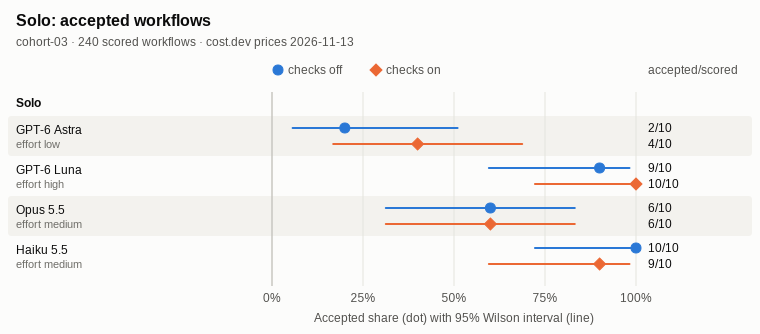
| Configuration | Checks | Accepted | 95% interval | Est. cost per accepted | Median minutes |
|---|---|---|---|---|---|
| Codex frontier (Astra, low) | off | 2 / 10 | 6–51% | ≥ $3.54 | 3.0 |
| Codex frontier (Astra, low) | on | 4 / 10 | 17–69% | ≥ $1.81 | 3.0 |
| Codex cheaper (Luna, high) | off | 9 / 10 | 60–98% | ≥ $0.014 | 3.4 |
| Codex cheaper (Luna, high) | on | 10 / 10 | 72–100% | ≥ $0.013 | 3.6 |
| Claude frontier (Opus 5.5, medium) | off | 6 / 10 | 31–83% | $0.94 ($0.62–1.94) | 2.4 |
| Claude frontier (Opus 5.5, medium) | on | 6 / 10 | 31–83% | $0.91 ($0.61–1.82) | 2.4 |
| Claude cheaper (Haiku 5.5, medium) | off | 10 / 10 | 72–100% | $0.043 ($0.040–0.046) | 3.7 |
| Claude cheaper (Haiku 5.5, medium) | on | 9 / 10 | 60–98% | $0.047 ($0.041–0.063) | 3.8 |
Bracketed ranges are 95% bootstrap intervals. Codex rows don’t have them because a lower-bound cost can’t support a two-sided interval.
In every within-tool comparison, the cheap setup passed more often than the frontier one. Luna hit 9 and 10 out of 10 against Astra’s 2 and 4; Haiku managed 10 and 9 against Opus’s 6 and 6. On Codex those intervals don’t even overlap. On Claude they do, and Haiku hitting 10 of 10 still leaves a 95% interval reaching down to 72%, so perfection on ten runs is no guarantee. Pooled together, the cheap models passed 38 of 40 runs (84–99% interval) while the frontier models passed 18 of 40 (31–60%). Nothing here makes a case for paying frontier prices on this workload. Every one of those frontier failures tripped on the exact same test, which I’ll dig into shortly.
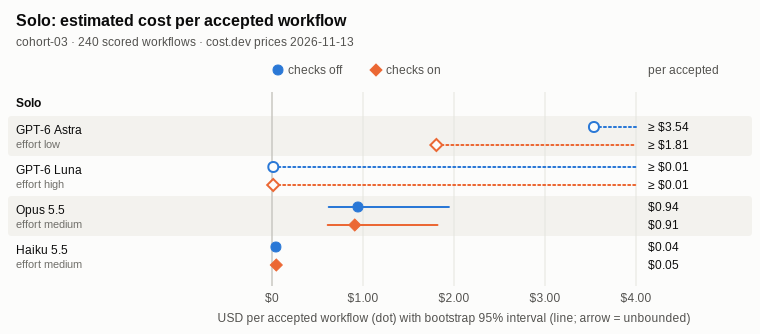
The price gap swamps the acceptance gap. Opus cost 22 times as much as Haiku per accepted result with checks off and 19 times with checks on, and their bootstrap intervals aren’t even close. Both Codex numbers are floors, though Luna would need at least 6.4 million unreported cache-write tokens per run (roughly 14 times its entire cached input) just to reach the lower of Astra’s two floors. I can’t tell you whether Luna or Haiku was actually cheaper. Luna’s floor is a third of Haiku’s cost, yet around 100,000 unreported cache-write tokens per run (less than a quarter of its cached input) would close that gap.
Checks never fired in the solo runs, or anywhere else in the experiment. Every single check run passed first try, so no repair feedback ever reached a model. Astra moved from 2 to 4 with checks on, Luna went from 9 to 10, Opus stayed flat at 6, and Haiku dipped from 10 to 9. With zero feedback delivered, the only difference between the two arms was a sentence in the prompt saying the runner would run checks at the end. Swings of one or two runs are normal noise in ten-run cells.
Running the checks barely cost any time either: 15.4 minutes across all 120 checks-on workflows, or 160 runs at a median of 5.5 seconds apiece. Median workflow duration was 4.8 minutes with checks on and 4.7 minutes with them off.
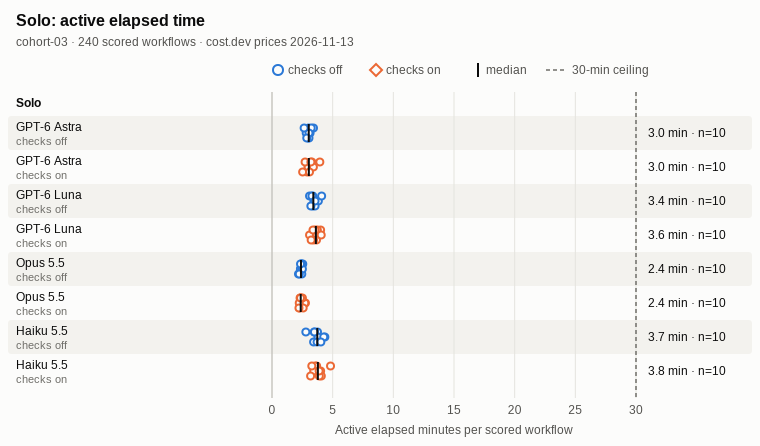
Solo medians sat between 2.4 and 3.8 minutes, with every solo workflow finishing inside 4.9 minutes.
Token mixes varied as much by coding tool as by model. Haiku’s ten solo runs with checks off read 7.8 million cached tokens and just 320 uncached; Luna reported 4.6 million cached and 346,000 uncached. Compare dollars and acceptance across tools, since raw token counts mean different things on each client.
Extension 1: frontier plans, cheaper implements
Here I wanted to see if having a frontier model write the plan lifts a cheap implementer above what either model achieves alone.
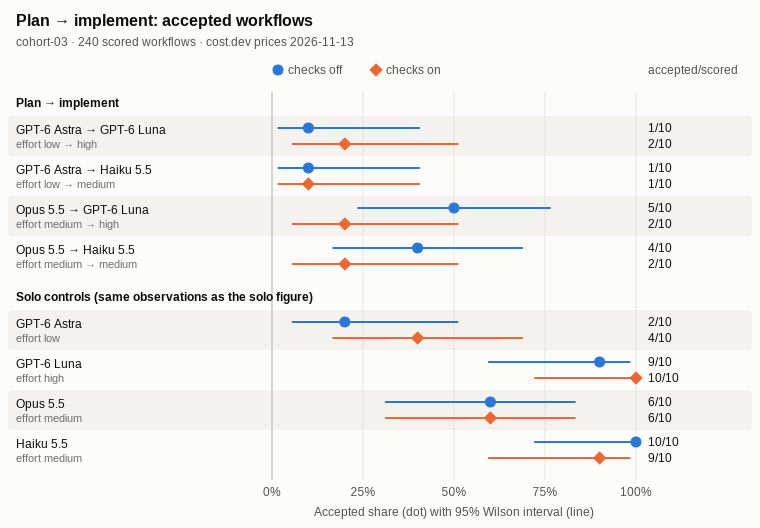
| Planner → implementer | Checks | Accepted | Est. cost per accepted | Planning cost / total, all 10 workflows | Median active min (IQR) |
|---|---|---|---|---|---|
| Astra → Luna | off | 1 / 10 | ≥ $3.56 | ≥ $3.42 / ≥ $3.56 | 5.6 (5.2–5.7) |
| Astra → Luna | on | 2 / 10 | ≥ $1.74 | ≥ $3.33 / ≥ $3.47 | 5.1 (4.9–5.4) |
| Astra → Haiku | off | 1 / 10 | ≥ $3.79 | ≥ $3.35 / ≥ $3.79 | 5.2 (4.8–5.7) |
| Astra → Haiku | on | 1 / 10 | ≥ $3.92 | ≥ $3.46 / ≥ $3.92 | 5.9 (5.4–5.9) |
| Opus → Luna | off | 5 / 10 | ≥ $0.46 | $2.18 / ≥ $2.32 | 4.6 (4.4–4.8) |
| Opus → Luna | on | 2 / 10 | ≥ $1.20 | $2.28 / ≥ $2.40 | 4.9 (4.3–5.0) |
| Opus → Haiku | off | 4 / 10 | $0.64 ($0.35–2.67) | $2.21 / $2.58 | 4.1 (4.0–4.7) |
| Opus → Haiku | on | 2 / 10 | $1.43 ($0.57–no limit) | $2.46 / $2.87 | 4.7 (4.4–5.1) |
IQR is the interquartile range (the middle 50% of workflow times). Opus → Haiku with checks on is the walkthrough condition from earlier.
Adding a planning step dragged acceptance down in all eight cells. Compared with the cheap implementers working solo (Luna at 9 and 10 of 10, Haiku at 10 and 9), the best planned pairing only managed 5 of 10. It didn’t help the planners either: Astra-planned runs scored 1 or 2 of 10 (below Astra solo’s 2 and 4), and Opus-planned runs scored 2 to 5 (below Opus solo’s 6 and 6). Meanwhile, the planner swallowed almost the entire bill. Opus’s ten plans per cell cost more than five times what Haiku spent writing the actual code, because at list rates a few thousand frontier output tokens cost more than an entire cheap-model build.
Comparing cost per accepted result against Opus solo ($0.94 and $0.91), only the all-Claude cells give exact figures. Opus → Haiku was cheaper with checks off ($0.64, though its bootstrap interval overlaps Opus’s widely) and dearer with checks on ($1.43). The Opus → Luna numbers are floors, so they only show that those pairings cost at least that much.
Checks sat idle here too. None of the 40 checks-on plan-and-implement workflows failed a check run.
You can trace most of the rejections straight back to the plans. 28 of the 40 Opus plans included a crash-recovery query that decrements the attempt counter for any job left running (attempts=MAX(attempts-1,0)), usually with the same reasoning from the walkthrough: an interrupted run shouldn’t count against the retry budget. 25 of those 28 workflows failed evaluation. Of the 12 workflows whose Opus plan skipped that query, 10 passed. Astra’s plans frequently did the same thing in prose, instructing the implementer to replay an interrupted job while “retaining its persisted attempt number”. A diligent cheap model tends to follow a confident plan, so it inherited the planner’s judgment call. In the three runs that passed despite a decrementing plan, the implementer caught the contradiction and sided with the spec.
Same-provider and cross-provider pairings bounced around with no clear pattern, so there’s nothing here I’d pin on mixing providers.
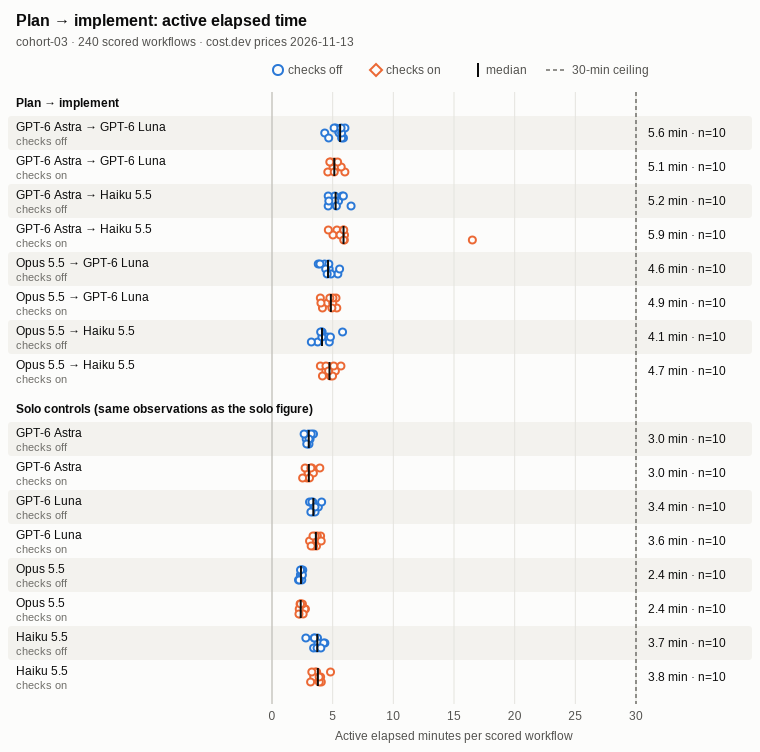
The table’s last column captures the same distribution, and figures/pi-elapsed.csv has every individual workflow. Planning slowed things down too: medians ran 4.1 to 5.9 active minutes compared with 2.4 to 3.8 solo. One Astra → Haiku run took 16.5 minutes, and every other run finished within 6.6. Active time covers all model stages, check runs, and handoffs. The independent evaluator sits outside that clock and took a median of about 21 seconds regardless of condition.
Extension 2: cheaper implements, frontier reviews, cheaper fixes
Next, a different way to spend frontier tokens: let a cheap model build the app first, have a frontier model review the finished code, then give the original cheap session one pass to apply fixes.
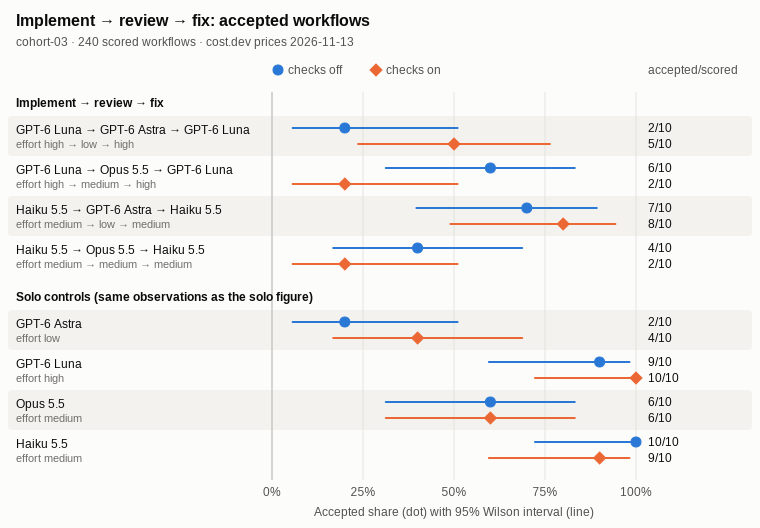
| Implementer → reviewer → fixer | Checks | Accepted | Est. cost per accepted | Total, all 10 workflows | Median active min (IQR) |
|---|---|---|---|---|---|
| Luna → Astra → Luna | off | 2 / 10 | ≥ $2.34 | ≥ $4.67 | 5.8 (5.6–6.4) |
| Luna → Astra → Luna | on | 5 / 10 | ≥ $0.88 | ≥ $4.41 | 5.7 (5.4–6.6) |
| Luna → Opus → Luna | off | 6 / 10 | ≥ $0.33 | ≥ $2.01 | 5.5 (5.4–5.7) |
| Luna → Opus → Luna | on | 2 / 10 | ≥ $0.97 | ≥ $1.94 | 5.8 (5.3–6.2) |
| Haiku → Astra → Haiku | off | 7 / 10 | ≥ $0.76 | ≥ $5.33 | 5.4 (5.0–6.0) |
| Haiku → Astra → Haiku | on | 8 / 10 | ≥ $0.61 | ≥ $4.85 | 6.0 (5.5–6.2) |
| Haiku → Opus → Haiku | off | 4 / 10 | ≥ $0.67 | ≥ $2.69 | 4.9 (4.4–5.3) |
| Haiku → Opus → Haiku | on | 2 / 10 | $1.28 ($0.54–no limit) | $2.56 | 5.0 (4.7–5.7) |
Haiku → Opus → Haiku with checks off is still a lower bound even though no Codex model ran, because it includes the workflow whose fix stage hit the 10-minute timeout and Claude Code was killed before logging that stage’s final token counts.
Here is how those condition totals split across the three stages. “Scheduled fix” is the single turn every workflow got to respond to the review. I left out a column for check repairs since none ever happened.
| Implementer → reviewer → fixer | Checks | Implement | Review | Scheduled fix | Total |
|---|---|---|---|---|---|
| Luna → Astra → Luna | off | ≥ $0.1297 | ≥ $4.4811 | ≥ $0.0634 | ≥ $4.6742 |
| Luna → Astra → Luna | on | ≥ $0.1256 | ≥ $4.2198 | ≥ $0.0633 | ≥ $4.4087 |
| Luna → Opus → Luna | off | ≥ $0.1231 | $1.8124 | ≥ $0.0711 | ≥ $2.0066 |
| Luna → Opus → Luna | on | ≥ $0.1252 | $1.7535 | ≥ $0.0633 | ≥ $1.9421 |
| Haiku → Astra → Haiku | off | $0.3926 | ≥ $4.8080 | $0.1273–0.1468 | ≥ $5.3278 |
| Haiku → Astra → Haiku | on | $0.3935 | ≥ $4.3213 | $0.1374 | ≥ $4.8522 |
| Haiku → Opus → Haiku | off | $0.3804 | $2.2246 | ≥ $0.0896 | ≥ $2.6946 |
| Haiku → Opus → Haiku | on | $0.3922 | $2.0768 | $0.0935 | $2.5625 |
Those numbers are estimated API-equivalent dollars from results/cohort-03-irf-roles.csv. Any sum touching a Codex stage is a lower bound, and rounding can leave a $0.0001 difference. One fix cell shows a range because a few requests didn’t attribute prompt length, so they’re priced between Haiku’s standard and long-context rates. Across ten runs, the fix stage cost six to fifteen cents. The reviewer was basically the whole bill.
Review fared better than planning overall (36 of 80 accepted versus 18 of 80). Stage budgets differ between the two workflows so it isn’t a strict apples-to-apples comparison, though seeing the actual code the cheap model wrote probably helped the reviewer do less damage than an upfront plan. Even so, it never beat the cheap model working alone. Every review condition scored worse than its implementer solo (Luna’s 9 and 10, Haiku’s 10 and 9) and cost far more per accepted result. The closest anyone got was Haiku → Astra → Haiku with checks on, at 8 of 10 against Haiku solo’s 9.
Compared against the frontier model working alone, review looks better with Astra and worse with Opus. Astra reviewing matched or beat Astra solo across all four cells (2 and 7 of 10 against Astra’s 2 with checks off, and 5 and 8 against 4 with checks on), though every cost there is a Codex floor. Opus reviewing matched Opus solo once (Luna → Opus → Luna with checks off, 6 against 6) and dropped below it in the other three cells (2, 4, and 2, against 6). The lone Opus-reviewed cell with an exact cost, Haiku → Opus → Haiku with checks on, landed at $1.28 per accepted result, more than Opus solo’s $0.91.
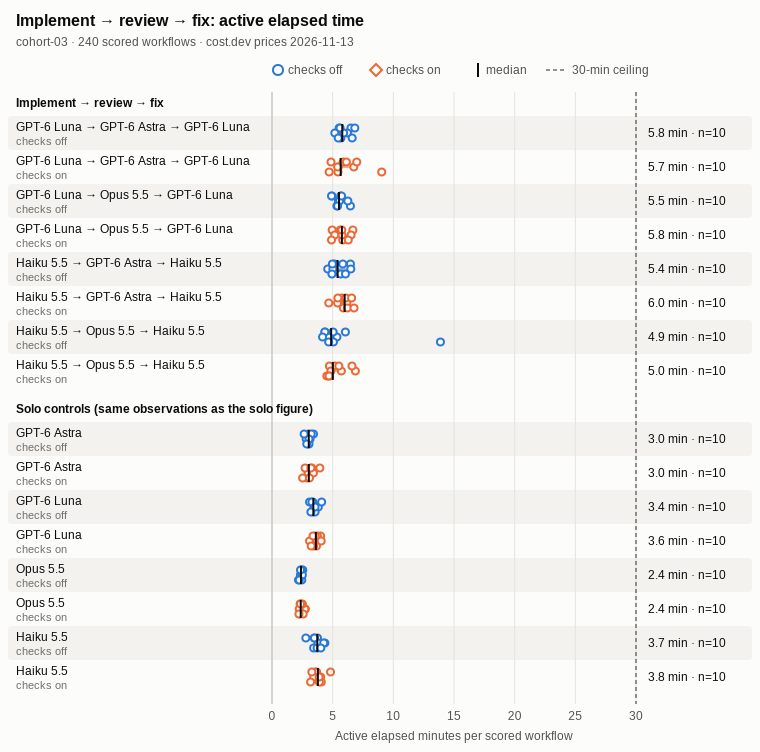
Again, the summary table carries the IQRs and figures/irf-elapsed.csv has every run. With three model turns, review had the slowest medians at 4.9 to 6.0 minutes. The timed-out run took 13.9 active minutes, and every other review workflow finished within 9.1.
Put both extensions side by side and neither beat the cheap model alone on this task, while taking longer to finish. The cheap model solo beat all 16 collaborative cells on acceptance. Haiku alone was at least 12 times cheaper per accepted result than any Haiku-implemented pairing with the same check setting. Luna alone would need at least 1.1 million unreported cache-write tokens per run (more than double its cached input) to lose on cost to the cheapest Luna-implemented pairing (Luna → Opus → Luna with checks off). If your current default is running a frontier model solo, having a cheap implementer build first and a frontier reviewer check it matched or beat that baseline in five of eight cells here, including all four where Astra reviewed.
Why the frontier models lost
Every single one of the 22 rejected solo frontier runs (14 from Astra, 8 from Opus) failed the exact same one of the evaluator’s 53 tests, and passed the other 52. In that restart test, the evaluator kills the worker mid-job, boots everything back up, and expects the job to finish with attempts equal to at least 2 (one for the interrupted attempt, plus the one that finished it). All 22 frontier runs reported 1. The cheap models working alone missed that case just once out of 40 runs.
Go back to the task brief and you can see why a thoughtful engineer might pause on it. The brief defines attempts as “the number of processing attempts started so far”, says each attempt “increments attempts”, and says a job left running when the worker dies “is processed again”. It also caps total attempts at three. Read literally, the interrupted attempt was started, so it counts. Yet if you read it with a production mindset, a job that happened to be running when a worker crashed on its third try would burn its last retry through no fault of the job itself.
The frontier models thought about that edge case. At least 13 of those 22 rejected runs wrote down their reasoning in a code comment or final summary. Astra wrote: “Restart its steps without consuming another retry: interruption is not a simulated dependency failure.” Opus wrote: “The interrupted attempt neither succeeded nor failed, so it is not counted.” One Opus run even flagged the trade-off for whoever read its output: “That keeps a crash from using up one of the 3 retries… The catch is that attempts then doesn’t count the attempt that was cut off. If you’d rather count it, it’s a one-line change.”
They did it deliberately, and in a real production system you could argue it’s the better design. Still, the acceptance suite was locked in before any model ran, based on the literal wording of the spec, and the cheap models simply built what the wording asked for. You see the exact same tug-of-war in reverse during the walkthrough: Opus’s plan made the clever design call, and Haiku overruled it by quoting the spec back.
So the frontier models lost here because this task was tightly specified and literal. On an open-ended task with gaps in the requirements, that same instinct is what makes a frontier model worth paying for. When every edge case is pinned down and tested, smart extrapolation becomes a liability. Spell out the exact behaviour you care about or put a test on it, instead of hoping a model reads your definitions literally. Rewriting one sentence about crash recovery in the brief would probably have swung these numbers more than swapping any model, though I didn’t re-run the suite to prove it.
What the checks didn’t see
Across all 130 rejected workflows in the whole benchmark, 128 failed that same restart test, and 125 failed only that test. The other five (all with Luna writing the code) failed browser UI tests (four runs) or a broader group including retries (one run). None of the runs failed to compile or even failed to start.
My build-time checks tested whether the app built, booted, and passed the disclosed API examples. I deliberately left crash recovery out of them so the build loop couldn’t teach directly to the hidden evaluator. Every one of the 160 check runs passed first time, which meant the runner sent zero repair feedback and waved through 67 builds that the evaluator later rejected.
The models were already catching the simple mistakes on their own. Even Codex, whose agents couldn’t boot the server inside their sandbox, never produced a build or startup failure. A harness only earns its keep on failures its checks can spot and the model’s native loop misses. Mine caught the obvious stuff the models were already getting right, and stayed blind to the one failure mode that actually showed up.
What this doesn’t show
- Small cells. With 10 runs per condition, 9 out of 10 gives a 95% interval from 60% to 98%. Most of the small gaps in these tables sit inside sampling noise. I’m reporting all 240 runs directly without significance testing, and ten runs on one app won’t tell you which model is “smarter” overall.
- A task well inside cheap models’ reach. Cheap models solo passed 38 of 40 times, leaving almost no failure rate for a frontier model to improve on. The stuff people actually lean on frontier models for (untangling big existing codebases, vague specs, tricky debugging, architecture calls, long-running sessions) wasn’t part of this test.
- A spec that rewards literal reading. The one test that decided almost everything punished a defensible design choice. Flip the task to reward judgment and the rankings could easily flip with it.
- Whole setups bundled together. Model, CLI tool, and effort level all moved together here. Inside Codex, I’m comparing low-effort Astra against high-effort Luna, and Astra on low might say more about the effort dial than the model. Across providers, Claude Code’s sandbox allowed starting the local server while Codex’s blocked local ports.
- Tight clocks. Workflows topped out at 30 minutes, with planning and review capped at 5. Whatever edge a frontier model builds up over an hour-long session never had time to appear.
- Messy token accounting. Each CLI counts tokens its own way, prompt caching happened naturally without controls, and Codex’s missing cache-write counts turn all its dollar figures into floors. Raw token counts across different tokenisers don’t line up directly, and the one timed-out Haiku stage left no final token numbers behind.
- Everything left out. Tasks where cheap models actually struggle, matched-tier pairings (frontier with frontier, cheap with cheap), cheap-leads pairings, a combined plan-review-fix loop, other effort settings, and tuning how often feedback fires (such as lighter checkpoints for frontier models).
Did building it pay for itself?
I can’t give you a clean dollar ROI on building the harness, though on this task the runtime checks clearly didn’t pay for themselves.
They never fired. All 160 check runs passed on the first shot, preventing zero failures, with overall acceptance at 53 of 120 with checks on and 57 of 120 with checks off (95% intervals of 36–53% and 39–56%). Checks didn’t hurt anything; they just sat there with nothing to catch.
Running them was quick (15.4 minutes across 120 workflows and no repair tokens spent). Still, cheap isn’t free. Because the checks never caught a bug, there’s no saving on the other side of the ledger to pay back the runtime or the hours spent building the harness.
Build effort is the hardest part to pin down. Coding agents built the benchmark under my direction: the effort log tracks roughly 85 minutes of agent wall-clock time across eight build slices, while a few earlier slices and all of my own design and review time weren’t logged. For the runs themselves, the models burned about 18.7 hours of active subscription time across the 240 scored workflows, plus 1.5 hours for evaluation and 2.0 hours of pilots.
If you want a rough break-even check for your own work, the math is straightforward: the failures your harness catches (times what each broken run costs you in review or cleanup) have to beat the extra tokens, the time to build it, and the monthly upkeep across whatever volume you run. Suppose, purely as a made-up example, your checks catch one bad run in fifty, each bad run would have cost you 20 minutes of review at $100 an hour, you run 500 tasks a month, and the harness took four hours to build plus an hour a month to keep working. That’s ten prevented failures worth around $333 a month against $100 of upkeep, paying back the four-hour build in under two months. On this job tracker I caught nothing, so how many real bugs your checks actually stop is the number to measure on your own codebase before assuming a harness pays off.
What I’d take from it day to day
Start with the cheap model when the work is well specified and you have a clear definition of done. Here it matched or beat the frontier models at a tiny fraction of the price. Save the frontier budget for messy requirements and unfamiliar codebases.
When you do hand work to a frontier model, expect it to use its judgment. It’ll make design calls your prompt didn’t ask for, and sometimes those calls are genuinely smart. If a specific behaviour matters, write it down plainly or lock it in with a test. And when agents keep failing the same way across runs, check the wording of your brief before reaching for a bigger model. Both tiers tripped on a single sentence’s worth of ambiguity here.
Be careful with model-written plans too. A confident plan passes its bad assumptions straight down to an obedient implementer, so treat a generated plan like code and check it against your requirements before kicking off the build.
Most of all, write checks for the bugs you actually see in review. Checking whether it compiles and boots adds very little when modern agent loops already verify that themselves. Look at why you reject agent PRs, test for those failures, and track cost per accepted result (failures included) on your own tasks before locking in a model routing rule.
Try it on your own task
The benchmark, raw logs, price snapshot, and analysis scripts live in a public repo, glenngillen/harness-benchmark, under the MIT licence. Everything in this post regenerates from the saved records with no API keys required: npm run analyse -- --label cohort-03 rebuilds the tables and SVGs, and npm run diagnose -- --label cohort-03 reproduces the failure breakdown and the walkthrough numbers. The README walks through both commands. It also explains how to run fresh workflows on your own subscriptions: in a new cohort from a Git checkout, leaving my cohort-03 records untouched.
If you want numbers from your own codebase, here’s how I’d set it up:
- Swap out the job tracker for a real, representative task from your repo that an agent should finish inside half an hour.
- Write the acceptance suite first as a black-box evaluator the agents can’t see, then check it against two or three deliberately broken builds to confirm they fail.
- Put together your build-time checks separately, aiming them at the kinds of bugs you actually catch in code review (beyond “it compiles”).
- Run a quick sanity check to verify each agent can actually execute its own verification commands inside its sandbox, since a sandbox silently blocking local ports changes what the native loop can see.
- Run the solo matrix first across the models you’re weighing up, with checks on and off, ten runs each.
- Price out accepted results with failed runs included, then read why each rejection failed. If your checks waved through work the evaluator rejected, tighten the checks before switching models. If a frontier model failed on a judgment call, decide whether to clarify the spec or change the test.
A harness only pays for itself if its checks catch the bugs your agents actually ship. Mine didn’t, and on a well-specified task that left the cheap model alone as the hardest option to beat.
Published:
I've spent most of my career working with or at startups. You'll usually find me working in Product leadership roles, on an advisory board, or maybe as an early investor.
I've been the VP of Product & GTM @ Ockam. I led the Terraform product team @ HashiCorp, where we launched Terraform 1.0, Terraform Cloud, and a whole host of amazing capabilities that set the stage for a successful IPO. Prior to that I was part of the Startup Team @ AWS, and earlier still an early employee @ Heroku. I've also invested in a couple of dozen early stage startups.